My Food Geek

he cooks, she eats :)

subscribe to
posts
comments

Almost Foolproof Macarons

June 8th, 2007 by geek

I’ve been toying with macaron recipes for some time now. In my recipes, there always seems like there is something that can go wrong. It could be the folding, it could be the unscientific drying time, or maybe it’s just my messed up oven, but something always goes wrong. Rarely do I get a sheet pan of perfectly formed macarons…until now.

This recipe just plain works. This recipe uses Italian meringue, don’t let it scare you. This one not so hard part is the reason why they work so well. You don’t have to mess around trying to get macaronage since the meringue is very stable. One of the nicest parts of this recipe is that you can double it, split it into two parts, color/flavor each separately, and get two flavors for the work of one recipe.

Here’s the recipe with details and photos:

For the Macarons:
120g egg whites, divided
35g sugar
150g finely ground almonds
150g powdered sugar

For the sugar syrup:
150g sugar and 50g water

Process the ground almonds and powdered sugar in the work bowl of a food processor. Most recipes call for sifting, but I think this works better and gets everything combined.

In a stand mixer, whip 60g egg whites to soft peaks, add 35g sugar.

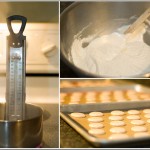
In the meantime, in a saucepan on high heat bring the water and sugar for the syrup to 230 F. on a candy thermometer.

sugar.jpg

Slowly add the boiling syrup to the egg whites and continue to whip on medium - high speed until they are completely cooled and you have a shiny meringue (10-15 minutes).

meringue.jpg

Mix the remaining 60g of egg whites and the sifted almond/sugar and carefully fold into the meringue.

bowl.jpg

fold.jpg

folded.jpg

Fill a pastry bag fitted with a plain tip with the mixture and pipe macarons about 3 inches in diameter on silpat lined baking sheet.

pipe.jpg

Bake at 320 for 15-25 minutes.

Check to see if macarons are done by grabbing the top of one macaron and trying to shake it. They are done when the top barely slides against the skirt. If they are not done, extend baking time by two minutes intervals, checking after each extension.

macaron.jpg

That’s about all that is to it. I think I’m finally done with macarons for a while. I’m sure the next time I try to make them I will encounter problems again, but until then…

Category: pastry | 23 Comments »

Weekend update

May 26th, 2007 by geek

A quick thanks to all the Daring Bakers that have welcomed me to the Eta Class. Also, the macaron post will be coming soon, I’m just fixing photos, writing, etc.

I’ve been having a hard time consistently writing posts these days so I thought I’d change things up and report on what’s happening at the food geek household this weekend.

I’ve been bitten by the macaron bug again. After seeing Brilynn post on her macarons and the problems she encountered and the renewed interest in a previous macaron post of mine, I have decided to make several batches this week and try out a new method or two. I’m hoping to get a recipe to work consistently but I’m not expecting any miracles.

The ice cream machine will be back in action this weekend! I bought some new, pint sized, containers and they need to be filled up. Frozen yogurt will be my main focus this week; I’m hoping to come up with a decent chocolate frozen yogurt recipe.

In other news, I am now the second male member of the Daring Bakers. I didn’t get accepted in time to participate in the May challenge but June is quickly approaching and I will finally be able to compete share with the group. If I have some extra time this weekend, I will try to come up with a male version of this graphic. I got some help on the side, but here’s the new graphic:

the dude

Category: kitchen | 17 Comments »

the fruits of my macaronage

March 7th, 2007 by geek

varimac.jpg

I admit, macaron madness has fully infected the foodgeek household. I must have made at least 7 batches of macarons trying to get a recipe to come out. I’d have entire pans of cracked cookies, pans that only half of them cracked, and others that were perfect.

What did I learn from all of this?

  • Do not fold the ingredients like you would a cake. The batter needs to be deflated a good deal to get that ‘flows like magma’ consistency.
  • Drying the macarons out before they are cooked provides insurance. While it may not be necessary, I found that the dried batches I made almost never cracked and always formed a proper foot.
  • I tried several oven temperatures, for the most part, they all worked. I settled on 335°F because it was what worked the best in the end
  • If you add coloring, do so to the egg whites at the end of beating and before folding in the dry ingredients.

With all of the mistakes I made, there was a good deal of success. At the end of all of my experiments, I was able to produce four sheets of uncracked macarons. With those four sheets, I managed to come up with four separate flavors: chocolate, lemon, raspberry, and banana caramel.

This recipe has evolved a little bit, here’s what I’m using now:

Basic Macaron Batter

65g almond powder
85g powdered sugar
2 egg whites
30g granulated sugar

Preheat oven to 335°F

Place almond powder and powdered sugar in a food processor. Process with metal blade until thoroughly combined.

Beat whites in a bowl with an electric mixer at high speed. As the whites begin to foam, add sugar in a slow stream while mixing. Continue mixing at high speed until whites reach stiff peaks.

Fold almond mixture into egg whites in two additions. The mixture will deflate quite a bit. Continue folding until mixture is fully combined and shiny. (and flows like MAGMA)

Immediately fill a pastry bag fitted with an 11mm round tip and pipe into rounds onto a baking sheet lined with a silpat baking mat.

Rap the baking sheet a few times firmly on the countertop to flatten the macaron.

Leave macarons out to dry for about 30 minutes or until they do not stick to your finger when touched.

When macarons are sufficiently dry, place in the oven to bake. After about five minutes, a ruffled skirt should develop around the bottom edge of each macaron. Rotate the baking sheet by 180 degrees, and bake for another five to seven minutes.

Check to see if macarons are done by grabbing the top of one macaron and trying to shake it. They are done when the top barely slides against the skirt. If they are not done, extend baking time by two minutes intervals, checking after each extension.

Move silpat to a cooling rack. After macarons have cooled enough to touch, remove them from silpat and place upside down on rack. If they do not easily come off silpat, place in freezer for a few minutes and try again.

macstacks.jpg

Category: pastry | 20 Comments »

macaron madness (a trip to the lab)

February 28th, 2007 by geek

Macarons are a strange pastry. They are comprised of three ingredients: almond powder, egg whites, and sugar, yet they can cause so many problems. I would say there’s at least a 15% chance of me screwing up a batch each time I make them. I figured I should do some research on what happened to my current batch in hopes to never let it happen again and, as a bonus, I will share it all with you.

First off we’ll start with my basic Macaron Batter.

115g almond powder
140g powdered sugar
90g egg whites
60g granulated sugar

I have been using this as the basis for all of my flavors. Checking various recipes over the web and scaling it appropriately, it seems like my recipe is a bit off which could be a problem. I seem to have less eggs and less powdered sugar than most other recipes. Here’s what I believe the recipe should look like:

100g almond powder
200g powdered sugar
120g egg whites (4)
65g powdered sugar

If you would like, you can easily add a few grams of flavoring, chocolate, matcha, rosewater, etc, and everything should work out fine in the end. To make pretty colors I use liquid food coloring.

Assembling the ingredients isn’t very hard. I usually take the almond powder and the powdered sugar and blend them in a food processor; you can also pass them both through a fine mesh drum sifter. I then make the meringue in my stand mixer. The dried goods are then incorporated into the meringue. Sounds easy, right? Here’s where the problems begin.

It is the process of mixing the almond mixture into the meringue is called “macaronage”

Clement over at A La Cuisine has a good write-up on the correct way to achieve macaronage:

The secret to making good macarons is to stir the batter to just the right consistency. Stir too little, and your macarons won’t have feet and will have a peak on their tops. But stir too much, and you’ll end up with flat, cracked, tough and chewy macarons. The best way to check for the correct consistency is to test if peaks in the batter quickly dissolve. I’ve also read that the batter should be mixed just until it ‘flows like magma.’ After the macarons have been piped, it’s important to let them rest until they’ve formed a skin.

Here is what happens when you screw up macaronage:

macbroke.jpg

Apparently I did not mix to the ‘flows like magma’ stage. The feet are non-existent, the tops cracked, and some are hollow. Next time I will make sure to use the best method for checking consistency as listed above.

Even our buddy David Lebovitz had his problems (forgive me while I try not to giggle) getting the correct foot and rise. While his note that true macarons could only be made in France is a load of crap, he did have an interesting discovery: You don’t have to let your macarons sit for hours, just pipe, whack them on the counter, and bake.

One last interesting point to mention is baking temperature. It seems like everyone likes to bake their macarons at a different temperature, too:

Foodgeek 305F
David Lebovitz 375F
Clement 325F (with a spoon in the door!)
Lynn 350F (300F in a convection oven)

I’ve looked at pictures of the final results and they all appear to be identical. I’m not sure why these vary so much but my best suggestion is to experiment a little and use what works for you.

So after much research, I have some new things to try. A new recipe, a few checks to make sure I achieve proper macaronage, no drying, and a new baking temperature. I don’t usually like changing so many things at once, but I’m going to go ahead and do it this one time. I’ll keep you guys updated with my research.

Category: pastry | 10 Comments »

And so it begins

December 10th, 2006 by eater

Such a fitting start, the beautiful French macaron: two smooth and delicate meringue-like rounds flavored however the chef pleases, usually made in someModeling Macarons beautiful pastel color that reflects the flavor, and sandwiched with some wonderful, complementary flavored filling between. They are generally made either as standard three inch rounds or small one inch miniatures.
He has made them in raspberry, blackberry, pistachio, chocolate, and orange with various fruit or chocolate fillings. They are always sublime creations that disappear quickly. The outside of the pastry has a slight crispness to it, and a slightly soft moistness inside with the center filling always an irresistible match.
His latest creation is a very Japanese take on the macaron, a green tea, or matcha, flavored pastry with red bean paste, or an, filling.

Matcha Macaron
110g almond powderSushi plate macarons
140g powdered sugar
7g matcha (powdered green tea)
90g egg whites
60g granulated sugar
Enough red bean paste to fill about five dozen miniature macarons

Preheat oven to 305°F

Place almond powder, powdered sugar, and matcha in a food processor. Process with metal blade until thoroughly combined.

Beat whites in a bowl with an electric mixer at high speed. As the whites begin to foam, add sugar in a slow stream while mixing. Continue mixing at high speed until whites reach stiff peaks.

Fold almond mixture into egg whites in three additions. The mixture will deflate quite a bit. Continue folding until mixture is fully combined and shiny.

Immediately fill a pastry bag fitted with a 11mm round tip and pipe into rounds onto a baking sheet lined with a silpat baking mat.

Leave macarons out to dry for about 30 minutes or until they do not stick to your finger when touched.

Drying Macarons

When macarons are sufficiently dry, place in the oven to bake. After about five minutes, a ruffled skirt should develop around the bottom edge of each macaron. Rotate the baking sheet by 180 degrees, and bake for another five to seven minutes.

Check to see if macarons are done by grabbing the top of one macaron and trying to shake it. They are done when the top barely slides against the skirt. If they are not done, extend baking time by two minutes intervals, checking after each extension.

Move silpat to a cooling rack. After macarons have cooled enough to touch, remove them from silpat and place upside down on rack.If they do not easily come off silpat, place in freezer for a few minutes and try again.

Sandwich macarons together with smooth red bean paste.

Piping Macaron Filling

Keep macarons in the freezer and serve chilled. Macarons are best the day after baking, giving them time to dry out a bit.

Makes about five dozen macarons.

Macarons in Dish

Category: pastry | 2 Comments »