My Food Geek

he cooks, she eats :)

subscribe to
posts
comments

A late baker

March 2nd, 2008 by geek

Late again?I hope this doesn’t become habit forming…

Daring Baguettes

This month the Daring Bakers chose a recipe by Boston’s own Julia Child: Baguettes. This recipe was probably 3 pages long and very detailed. I’m not listing it here, but I’m sure you can find it on another Daring Baker’s site.

While mine did not come out as perfect as I wanted, the taste and texture were pretty good for skipping a two steps in the recipe.

The first step I omitted with proofing the bread on a cloth. I searched high and low but could not find anything appropriate in my house to this sort of application. I ended up proofing them on a silpat, on the counter, with a small tea towel draped over them.

The second step omitted, which is pretty important, was I didn’t cook with steam. I tried spritzing the loaves with a sprayer but omitted any of the other (very important) steps the recipe suggested for producing steam in a home oven.

The results were decently shaped baguettes with a crust that wasn’t as crunchy as I hoped. This didn’t stop me from eating an entire baguette with jam though, they were more than tasty. Would I try this recipe again? Maybe. If I use the recipe again, there are a few things I would change:

  • I’d skip the whole cloth proofing and just use a sheet pan with a towel over the top
  • I wouldn’t try to flip the proofed loaves over and THEN cook them, too much risk
  • Create steam in the oven, it is important for the crust formation
  • Less flour, more water. I even thought the recipe had a high hydration factor, but I was wrong.
  • Take more pictures and show them off!

These baguettes featured in a salad I made later in the week, as well. They were thinly sliced and toasted and served with a grilled goat cheese; I then paired that with a golden beet salad. I jokingly called it, “The Yellow Beet Road.”

Goat and Beet

While I really love these French-style baguettes, I’ve started to acquire a taste for the Vietnamese-style baguettes. The Asian-inspired breads had a bit lighter texture and had a better crust formation even without steam. The recipe was a little bit less involved, too!

Category: pastry, savory | 2 Comments »

A wicked nice surprise

January 4th, 2008 by geek

A few weeks back I saw this picture on a fellow blogger’s site.
tools

Chris, the fellow blogger, got her hands on about 50 of these mini brioche molds for an amazing deal. She happened to obtain these tins just about the same time I was making my kitchenaid brioche. In a flash I shot off a comment on her blog and begged asked nicely if she could grab some for me in exchange for a small reward. I was a little bit surprised when I got a response from her. Chris said she’d try and pick some up for me and would mail them to me if she could find them. I honestly thought she was just being nice and I would never see anything in the mail, even though she requested my address.

About a week and a half ago a received a mysterious package in the mail. In the package was the mini brioche tins, some fancy pastel-colored measuring spoons, recipe cards, and a Christmas card. I was amazed! Not only by the package but by the kindness a fellow blogger had for me.
Chris, I owe you: pretty much anything I can get you from the Boston area is yours!

Category: pastry | 3 Comments »

Daring Christmas

December 26th, 2007 by geek

I’m a few days late with my DB post this month, but I got it done in time for Christmas Eve.
Tired Gnome

This month our daring assignment got a holiday themed recipe: Yule Log. This is one of those recipes that may make you cringe a little bit when you first look at it; a cake, frosting, and two garnishes. There isn’t a whole lot to worry about here if you take your time and plan accordingly. Both the cake and the buttercream use similar methods of heating the eggs and sugar over a bain-marie, if you get one right, you should be able to have success with both.

I have to admit that I got to see a few of these completed before I even started making my pastry and I took some inspiration from a few of you out there. I decided to fill my cake with vanilla scented pears and frost the whole thing with chocolate buttercream. I may have deviated a little bit from the recipe suggestions, but I’m not a huge fan of coffee and the color just didn’t seem dark enough for me. The pears and their juices soaked into the cake nicely so no additional soaking syrup was needed. The cake ended up nice and moist with just enough fruit in each bite while not being overpowered by the chocolate buttercream.

I was surprised by how much frosting this recipe yielded. There is probably enough frosting here for me to frost three of these cakes! I’m sure I can find a use for the massive amounts leftover, but I’d consider at least halving the recipe even if you are going to use the buttercream as a filling as well.

I skipped out on the meringue mushrooms and just went with marzipan decorations. The marzipan was quite easy to work with and the color worked nicely for some mushrooms, acorns, and a forest gnome (with axe!). I colored the marzipan brown with some cocoa powder which made it slightly chocolaty as well.

The log

Yule Log

Plain Genoise:

3 large eggs
3 large egg yolks
pinch of salt
¾ cup of sugar
½ cup cake flour - spoon flour into dry-measure cup and level off (also known as cake & pastry flour)
¼ cup cornstarch

one 10 x 15 inch jelly-roll pan that has been buttered and lined with parchment paper and then buttered again

1.Set a rack in the middle of the oven and preheat to 400 degrees F.

2.Half-fill a medium saucepan with water and bring it to a boil over high heat. Lower the heat so the water is simmering.

3.Whisk the eggs, egg yolks, salt and sugar together in the bowl of a heavy-duty mixer. Place over the pan of simmering water and whisk gently until the mixture is just lukewarm, about 100 degrees if you have a thermometer (or test with your finger - it should be warm to the touch).

4.Attach the bowl to the mixer and, with the whisk attachment, whip on medium-high speed until the egg mixture is cooled (touch the outside of the bowl to tell) and tripled in volume. The egg foam will be thick and will form a slowly dissolving ribbon falling back onto the bowl of whipped eggs when the whisk is lifted.

5.While the eggs are whipping, stir together the flour and cornstarch.

6.Sift one-third of the flour mixture over the beaten eggs. Use a rubber spatula to fold in the flour mixture, making sure to scrape all the way to the bottom of the bowl on every pass through the batter to prevent the flour mixture from accumulating there and making lumps. Repeat with another third of the flour mixture and finally with the remainder.

7.Scrape the batter into the prepared pan and smooth the top.

8.Bake the genoise for about 10 to 12 minutes. Make sure the cake doesn’t overbake and become too dry or it will not roll properly.

9.While the cake is baking, begin making the buttercream.

10.Once the cake is done (a tester will come out clean and if you press the cake lightly it will spring back), remove it from the oven and let it cool on a rack.

Coffee Buttercream:

4 large egg whites
1 cup sugar
24 tablespoons (3 sticks or 1-1/2 cups) unsalted butter, softened
2 tablespoons instant espresso powder
2 tablespoons rum or brandy

1.Whisk the egg whites and sugar together in the bowl of an electric mixer. Set the bowl over simmering water and whisk gently until the sugar is dissolved and the egg whites are hot.

2.Attach the bowl to the mixer and whip with the whisk on medium speed until cooled. Switch to the paddle and beat in the softened butter and continue beating until the buttercream is smooth. Dissolve the instant coffee in the liquor and beat into the buttercream.

Filling and frosting the log:

1.Run a sharp knife around the edges of the genoise to loosen it from the pan.

2.Turn the genoise layer over (unmolding it from the sheet pan onto a flat surface) and peel away the paper.

3.Carefully invert your genoise onto a fresh piece of parchment paper.

4.Spread with half the coffee buttercream (or whatever filling you’re using).

5.Use the parchment paper to help you roll the cake into a tight cylinder.

6.Transfer back to the baking sheet and refrigerate for several hours.

7.Unwrap the cake. Trim the ends on the diagonal, starting the cuts about 2 inches away from each end.

8.Position the larger cut piece on each log about 2/3 across the top.

9.Cover the log with the reserved buttercream, making sure to curve around the protruding stump.

10.Streak the buttercream with a fork or decorating comb to resemble bark.

11.Transfer the log to a platter and decorate with your mushrooms and whatever other decorations you’ve chosen.

Meringue Mushrooms:

3 large egg whites, at room temperature
¼ teaspoon cream of tartar
½ cup (3-1/2 ounces/105 g.) granulated sugar
1/3 cup (1-1/3 ounces/40 g.) icing sugar
Unsweetened cocoa powder for dusting

1.Preheat the oven to 225 degrees F. Line 2 baking sheets with parchment. Have ready a pastry bag fitted with a small (no. 6) plain tip. In a bowl, using a mixer on medium-low speed, beat together the egg whites and cream of tartar until very foamy. Slowly add the granulated sugar while beating. Increase the speed to high and beat until soft peaks form when the beaters are lifted. Continue until the whites hold stiff, shiny peaks. Sift the icing sugar over the whites and, using a rubber spatula, fold in until well blended.

2.Scoop the mixture into the bag. On one baking sheet, pipe 48 stems, each ½ inch (12 mm.) wide at the base and tapering off to a point at the top, ¾ inch (2 cm.) tall, and spaced about ½ inch (12 mm.) apart. On the other sheet, pipe 48 mounds for the tops, each about 1-1/4 inches (3 cm.) wide and ¾ inch (2 cm.) high, also spaced ½ inch (12 mm.) apart. With a damp fingertip, gently smooth any pointy tips. Dust with cocoa. Reserve the remaining meringue.

3.Bake until dry and firm enough to lift off the paper, 50-55 minutes. Set the pans on the counter and turn the mounds flat side up. With the tip of a knife, carefully make a small hole in the flat side of each mound. Pipe small dabs of the remaining meringue into the holes and insert the stems tip first. Return to the oven until completely dry, about 15 minutes longer. Let cool completely on the sheets.

4.Garnish your Yule Log with the mushrooms.

Marzipan Mushrooms:

8 ounces almond paste
2 cups icing sugar
3 to 5 tablespoons light corn syrup
Cocoa powder

1.To make the marzipan combine the almond paste and 1 cup of the icing sugar in the bowl of an electric mixer and beat with the paddle attachment on low speed until sugar is almost absorbed.

2.Add the remaining 1 cup of sugar and mix until the mixture resembles fine crumbs.

3.Add half the corn syrup, then continue mixing until a bit of the marzipan holds together when squeezed, adding additional corn syrup a little at a time, as necessary: the marzipan in the bowl will still appear crumbly.

4.Transfer the marzipan to a work surface and knead until smooth.

5.Roll one-third of the marzipan into a 6 inches long cylinder and cut into 1-inch lengths.

6.Roll half the lengths into balls. Press the remaining cylindrical lengths (stems) into the balls (caps) to make mushrooms.

7.Smudge with cocoa powder.

Category: pastry | 23 Comments »

Potato Bread

November 27th, 2007 by geek

Focaccia

This month the Daring Bakers tackled yet another yeast-based product, potato bread. I didn’t participate in the last yeast challenge (sticky buns) so I figured I should step up and complete this one.

It’s no secret that I was disappointed when I saw a basic bread recipe. I was hoping for some intricate pastry or a recipe with a high degree of difficulty, but this is what we got. Since I complained a little, I really needed to finish this one and make sure I didn’t screw up.

Braid

I came up with four variations of the theme: A boule, focaccia, a four-braid loaf, and a decorative piece made from some remaining dough. The basic dough could take a few additional ingredients like olives, onions, garlic, or herbs. As usual, I waited until the last day to make this so I wasn’t prepared to modify the recipe with anything extra. The recipe works as is and won’t throw any curve balls at you. The resulting product is a light-airy bread with a decent crumb and a nice crust.

Boule
Tender Potato Bread

Challenge Recipe:

Metric measurements are from the European edition.

Ingredients:

4 medium to large floury (baking) potatoes, peeled and cut into chunks.
Tanna Note: For the beginner bread baker I suggest no more than 8 ounces of potato; for the more advanced no more than 16 ounces. The variety of potatoes you might want to use would include Idaho, Russet & Yukon gold, there are others.

4 cups(950 ml) water, reserve cooking water
1 tablespoon plus 1 teaspoon salt
2 teaspoons active dry yeast
6 ½ cups to 8 ½ cups (1 kg to 1350g) unbleached all-purpose
1 tablespoon unsalted butter, softened
1 cup (130g) whole wheat flour

Making the Dough (Directions will be for making by hand):

Put the potatoes and 4 cups water in a sauce pan and bring to boil. Add 1 teaspoon salt and cook, half covered, until the potatoes are very tender.

Drain the potatoes, SAVE THE POTATO WATER, and mash the potatoes well. Tanna Note: I have a food mill I will run my potatoes through to mash them.

Measure out 3 cups(750ml) of the reserved potato water. Add extra water if needed to make 3 cups. Place the water and mashed potatoes in the bowl you plan to mix the bread dough in. Let cool to lukewarm (70-80°F/21 - 29°C) – stir well before testing the temperature – it should feel barely warm to your hand. You should be able to submerge you hand in the mix and not be uncomfortable.

Add yeast to 2 cups all-purpose flour and whisk. Add yeast and flour to the cooled mashed potatoes & water and mix well. Allow to rest/sit 5 minutes.
Note about Adding Yeast: If using Active Dry Yeast or Fresh yeast, mix & stir yeast into cooled water and mashed potatoes & water and let stand 5 minutes. Then add 2 cups of flour to the yeast mix and allow to rest several minutes. If using Instant Dry Yeast, add yeast to 2 cups all-purpose flour and whisk. Add yeast and flour to the cooled mashed potatoes & water and mix well. Allow to rest/sit 5 minutes.
Sprinkle in the remaining 1 tablespoon salt and the softened butter; mix well. Add the 1 cup whole wheat flour, stir briefly.

Add 2 cups of the unbleached all-purpose flour and stir until all the flour has been incorporated.
Tanna Note: At this point you have used 4 cups of the possible 8 ½ cups suggested by the recipe.
Turn the dough out onto a generously floured surface and knead for about 10 minutes, incorporating flour as needed to prevent sticking. The dough will be very sticky to begin with, but as it takes up more flour from the kneading surface, it will become easier to handle; use a dough scraper to keep your surface clean. The kneaded dough will still be very soft. Place the dough in a large clean bowl or your rising container of choice, cover with plastic wrap or lid, and let rise about 2 hours or until doubled in volume.

Turn the dough out onto a well-floured surface and knead gently several minutes. It will be moist and a little sticky.

Forming the Bread:
Tanna Note: It is at this point you are requested to Unleash the Daring Baker within. The following is as the recipe is written. You are now free to follow as written or push it to a new level.

Divide the dough into 2 unequal pieces in a proportion of one-third and two-thirds (one will be twice as large as the other). Place the smaller piece to one side and cover loosely.
To shape the large loaf:
Butter a 9 x 5 x 2.5 inch loaf/bread pan. Flatten the larger piece of dough on the floured surface to an approximate 12 x 8 inch oval, then roll it up from a narrow end to form a loaf. Pinch the seam closed and gently place seam side down in the buttered pan. The dough should come about three-quarters of the way up the sides of the pan. Cover with plastic wrap and let rise for 35 to 45 minutes, until puffy and almost doubled in volume.

To make a small loaf with the remainder:
Butter an 8×4X2 inch bread pan. Shape and proof the loaf the same way as the large loaf.

To make rolls:
Butter a 13 x 9 inch sheet cake pan or a shallow cake pan. Cut the dough into 12 equal pieces. Shape each into a ball under the palm of your floured hand and place on the baking sheet, leaving 1/2 inch between the balls. Cover with plastic wrap and let rise for about 35 minutes, until puffy and almost doubled.

To make focaccia:
Flatten out the dough to a rectangle about 10 x 15 inches with your palms and fingertips. Tear off a piece of parchment paper or wax paper a little longer than the dough and dust it generously with flour. Transfer the focaccia to the paper. Brush the top of the dough generously with olive oil, sprinkle on a little coarse sea salt, as well as some rosemary leaves, if you wish and then finally dimple all over with your fingertips. Cover with plastic and let rise for 20 minutes.

Baking the bread(s):

Note about baking order: bake the flat-bread before you bake the loaf; bake the rolls at the same time as the loaf.

Note about Baking Temps: I believe that 450°F(230°C) is going to prove to be too hot for the either the large or small loaf of bread for the entire 40/50 minutes. I am going to put the loaves in at 450°(230°C) for 10 minutes and then turn the oven down to 375°F (190 °C) for the remaining time.

Note about cooling times: Let all the breads cool on a rack for at least 30 minutes before slicing. Rolls can be served warm or at room temperature.

For loaves and rolls:
Dust risen loaves and rolls with a little all-purpose flour or lightly brush the tops with a little melted butter or olive oil (the butter will give a golden/browned crust). Slash loaves crosswise two or three times with a razor blade or very sharp knife and immediately place on the stone, tiles or baking sheet in the oven. Place the rolls next to the loaf in the oven.

Bake rolls until golden, about 30 minutes. Bake the small loaf for about 40 minutes. Bake the large loaf for about 50 minutes.

Transfer the rolls to a rack when done to cool. When the loaf or loaves have baked for the specified time, remove from the pans and place back on the stone, tiles or baking sheet for another 5 to 10 minutes. The corners should be firm when pinched and the bread should sound hollow when tapped on the bottom.

For foccaia:
Place a baking stone or unglazed quarry tiles, if you have them, if not use a no edged baking/sheet (you want to be able to slide the shaped dough on the parchment paper onto the stone or baking sheet and an edge complicates things). Place the stone or cookie sheet on a rack in the center of the oven and preheat to 450°F/230°C.

If making foccacia, just before baking, dimple the bread all over again with your fingertips. Leaving it on the paper, transfer to the hot baking stone, tiles or baking sheet. Bake until golden, about 10 minutes. Transfer to a rack (remove paper) and let cool at least 10 minutes before serving.

Dough

Category: pastry | 23 Comments »

Bostini!

October 29th, 2007 by geek

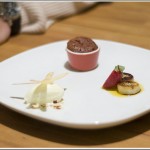
Bostini Cream Pie

I cut this Daring Bakers Challenge close. I waited until the last day and pretty close to the last hour to get this cake made and posted!

This month the bakers took on the challenge of a Bostini Cream Pie. I’d probably classify this as a restaurant version of the classic dessert; it is small, loaded with eggs and cream, and intended to be made in individual servings. If you check the recipe, you’ll see that the recipe is actually from a restaurant so my initial impressions were correct.

As is true with many pastries, this one is easily broken into several basic parts: chiffon, pastry cream, and ganache. I chose to make a few (allowed) adjustments to the recipe: using coconut milk in place for orange juice, only making a half recipe of pastry cream, and coming up with my own presentation. I was surprised to see how much pastry cream there was leftover even with half the recipe; I’m sure I can find a way to make it disappear though.

I served this to the eater and my parents tonight and the pies disappeared shortly before I was done taking photos. I’d consider making this dessert again but I’d change a few things up that are mostly personal preference. I’d probably choose a thinner cake like a joconde and would most definitely use a pastry cream that is a bit less rich. I was really surprised at how thick it was after it was chilled. I prefer a cream with a lighter, less dense, texture. I might even soak the sponge with some sort of boozey concoction that would tie all the flavors together.

Here’s the original recipe to try, if you dare…

Bostini Cream Pie
(from Donna Scala & Kurtis Baguley of Bistro Don Giovanni and Scala’s Bistro)
Makes 8 generous servings

INGREDIENTS:

Custard

3/4 cup whole milk
2 3/4 tablespoons cornstarch
1 whole egg, beaten
9 egg yolks, beaten
3 3/4 cups heavy whipping cream
1/2 vanilla bean
(EDITED: vanilla extract is okay)
1/2 cup + 1 tablespoon sugar

Chiffon Cake

1 1/2 cups cake flour
3/4 cup superfine sugar
1 1/3 teaspoons baking powder
1/3 teaspoon salt
1/3 cup canola oil
1/3 cup beaten egg yolks (3 to 4 yolks)
3/4 cup fresh orange juice
1 1/2 tablespoons grated orange zest
1 teaspoon pure vanilla extract
1 cup egg whites (about 8 large)
1 teaspoon cream of tartar

Chocolate Glaze

8 ounces semi or bittersweet chocolate
8 ounces unsalted butter

INSTRUCTIONS

To prepare the custard:

Combine the milk and cornstarch in a bowl; blend until smooth. Whisk in the whole egg and yolks, beating until smooth. Combine the cream, vanilla bean and sugar in a saucepan and carefully bring to a boil. When the mixture just boils, whisk a ladleful into the egg mixture to temper it, then whisk this back into the cream mixture. Cook, stirring constantly, until the mixture is thick enough to coat the back of a spoon. Strain the custard and pour into 8 large custard cups. Refrigerate to chill.

To prepare the chiffon cakes:

Preheat the oven to 325°F. Spray 8 molds with nonstick cooking spray. You may use 7-ounce custard cups, ovenproof wide mugs or even large foil cups. Whatever you use should be the same size as the custard cups.

Sift the cake flour, sugar, baking powder and salt into a large bowl. Add the oil, egg yolks, orange juice, zest and vanilla. Stir until smooth, but do not overbeat.

Beat the egg whites until frothy. Add the cream of tartar and beat until soft peaks form. Gently fold the beaten whites into the orange batter. Fill the sprayed molds nearly to the top with the batter.

Bake approximately 25 minutes, until the cakes bounce back when lightly pressed with your fingertip. Do not overbake. Remove from the oven and let cool on a wire rack. When completely cool, remove the cakes from the molds. Cover the cakes to keep them moist.

To prepare the glaze:

Chop the chocolate into small pieces. Place the butter in a saucepan and heat until it is just about to bubble. Remove from the heat; add the chocolate and stir to melt. Pour through a strainer and keep warm.

To assemble:

Cut a thin slice from the top of each cake to create a flat surface. Place a cake flat-side down on top of each custard. Cover the tops with warm chocolate glaze. Serve immediately.

the dude

Category: pastry | 31 Comments »