My Food Geek

he cooks, she eats :)

subscribe to
posts
comments

Kitchenaid Brioche — step-by-step for Amanda

November 18th, 2007 by geek

A long time ago a fellow San Diego blogger was gifted a Kitchenaid stand mixer and asked me for a mixer-friendly brioche recipe. This is probably a few months late but….

Brioche
Brioche is an enriched French bread with a large amount of butter and eggs that gives this bread a soft, sweet crumb. Brioche are formed into many different shapes but the brioche a tete is probably the most widely known. They’re usually cooked in small fluted pans with an extra small bun on top.

Brioche

You can see here that I had my best go at the ‘a tete’ variety. I didn’t have access to the small fluted pans so I used a large muffin pan and tried and stay with the theme. They don’t quite look as beautiful without the fluted sides but the muffin pan worked in a pinch and produced a reasonable facsimile.

What many people don’t know is that brioche is made into other shapes including plain old loafs of bread. It seems like brioche should deserve a better fate than a normal loaf, but on the contrary, it is as a loaf that it really shines. When baked as a loaf it can be transformed into some really rich French toast, a mean bread pudding, or just the best slice of white bread and jam you’ve ever had.

Brioche

This is a recipe that I learned while I was a student at the San Diego Culinary Institute. Our instructor, Yves Fournier, an accomplished pastry chef, was the son of a baker in France. Yves would always give us practical baking tips, whether it was the correct way to shape baguettes, form croissants, or make brioche, he was always full of useful baking knowledge. While we were learning how to make brioche, Yves showed us an alternative way to make this rich dough using a commercial mixer.

This recipe is a little different than a lot of the brioche recipes you will see out there; don’t worry, it works just as well (or even better).

Brioche

Brioche

500g flour
65g sugar
15g salt
15g yeast
6eggs + H20
250g butter, softened

Dissolve the yeast in a small amount of warm (100F) water. You don’t need much water here, just enough to get the yeast to dissolve.

Combine eggs, sugar, yeast mixer, and all the flour in the work bowl of the mixer. Mix using the dough hook until all the ingredients come together. Add salt.

At this point you will need to adjust the consistency of the dough. If the dough is too tough, adjust consistency with a little more water. If the dough is too wet, add enough flour until you have a soft, tacky dough.

Add all the butter to the dough and continue to knead until the dough absorbs all the butter. You may still need to adjust the dough with a little more flour. It is ok to have a sticky dough but it should still be able to hold it’s shape somewhat.

Remove the dough from the mixer and form into a tight ball.

Place dough in an oiled bowl and refrigerate the dough overnight.

When ready to use the dough, remove from the chiller and allow to return to room temperature. Let rise until dough has doubled in size. Punch dough down and shape into loaves, buns, or whatever you desire.

Proof shaped dough until doubled in size. Brush egg wash over the tops of the dough and bake at 375F for about 25-35 minutes and golden brown.

Category: pastry | 7 Comments »

Choux, many ways

November 9th, 2007 by geek

choux paste

Choux paste is one mighty useful item. It is one of those recipes that can be transformed into so many different things. The French flavor it with savory ingredients and pipe small bits of it into boiling water and call it French Gnocchi. In southwestern US long strips are piped with a star tip into boiling oil then covered with cinnamon sugar and called churros. The French also give it a similar deep-frying but with cheese added to the paste and call them gougeres. The most common of uses is probably baked goods like chocolate eclairs. Here’s a look at several variations on the baked good which may or may not be familiar to you.
Profiterole

Profiteroles are the classic sphere-shaped choux puffs that are split in half, filled with ice cream, and topped off with chocolate sauce. These lovely pastries usually pop up in French restaurants and bistros and they’re easily reproduced at home. This example was put together with some leftovers I had in the kitchen: frozen choux puffs, chai tea ice cream, and whole butter ganache from my Bostini Cream pie. I like to keep richer desserts like this on the small side. The full flavor of the ice cream and the rich taste of the ganache can be too much on a restaurant sized dessert.
mini eclair

I think everyone is familiar with eclairs. You can find these things at just about any supermarket or bakery if you’re lucky to find one in the states. In my opinion, they are always made wrong: they’re huge, they’re soggy, and they’re too sweet. I find that small, bite-sized eclairs are more satisfying to eat and lend themselves well to a pastry platter. At this small size, it is easy to change up the fillings and icings and experiment. I was a little bit lazy and filled all of these with a praline diplomat cream and just varied the icings to make the display more visually appealing.

Paris Brest

The name of these pastries will bring a smile to your twelve year old brain: Paris-Brest. No, not that breast! These pastries were created in honor of the Paris-to-Brest-to-Paris bike race that started over one-hundred years ago. They are supposed to represent either a bicycle wheel or the round trip ride, either way, they’re good. They are classically topped with sliced almonds and filled with an almond praline pastry cream. Sometimes they are dusted with powdered sugar, sometimes they aren’t.
chouxquette

I recently learned about these little pastries called Chouquettes from an old post on David Lebovitz’s site. These little snacks are small bites of choux paste that are usually covered with very course, crackly sugar and left unfilled. While I couldn’t fine any of that stuff around these parts, I did have some large-grained Maui sugar that worked quite well. These things are borderline addictive, yet so simple you can’t imagine why they’d be so good. Imagine a light and crispy cookie with just a crunchy sweetness on top, that’s a chouquette!
Religieuse

The final choux I created was the Religeuse. These are supposed to resemble a little nun but I’m not entirely convinced. This pastry is comprised of one large choux puff and one small choux puff, filled with pastry cream, dipped in poured fondant, stacked up, and decorated with icing. These are usually medium sized pastries about the size of your palm. Laduree, the famous macron people, are also somewhat famous for their Religeuse. They ice and fill their pastries with exotic ingredients like rose, tomato, and black truffle. I wasn’t so daring and used a mocha faux-fondant and the praline diplomat cream from the eclairs.

In the end, choux recipes don’t really vary all that much. I really liked this recipe from Michel Roux’s Finest Desserts because the proportions were easy to remember and the choux came out nice and smooth. If you desire, you can either use all milk, all water, or both like I used here. I don’t really see much of a difference in the end product but I haven’t thoroughly tested the variations.

You can use this recipe for all of the creations I’ve listed above. Profiteroles, chouquettes, and religeuse are all made with small balls of dough either piped or made with a spoon. Eclairs and the Paris Brest should be piped out to the desired shape. All of these pastries will benefit from a light eggwash before cooking and a slight flattening with the back of a fork to promote even puffing in the oven.

Choux paste:

125ml water
125ml milk
100g butter (diced)
pinch of salt
pinch of sugar

150g flour
4 eggs

egg wash (1 egg with a pinch of salt and a little water)

Combine the water, milk, butter, salt, and sugar in a saucepan and boil over high heat. Continue boiling until all of the butter is completely melted.

Remove pan from heat and quickly dump all of the flour into the liquid. Stir continuously until a smooth paste is formed.

Return the pan to the heat and stir the paste with a spatula for one minute. Try not to let the paste dry out too much or it may crack during baking which will affect the presentation of your choux puffs.

Transfer the paste to a bowl and immediately use a spatula to beat the eggs in one by one. Beat the paste until it is very smooth.

The choux paste is now ready to use. If you are not going to use it right away, press plastic wrap on top of the paste and refrigerate for up to three days.

If you are cooking your choux immediately, pipe into the desired shape on a parchment or silpat lined baking sheets and bake at 425F for 8 minutes then lower the oven to 375F for about 15 minutes more or until the choux are golden brown and mostly dried out. You may have to sacrifice one to test for doneness, but it is worth it.

Category: pastry | 7 Comments »

Bostini!

October 29th, 2007 by geek

Bostini Cream Pie

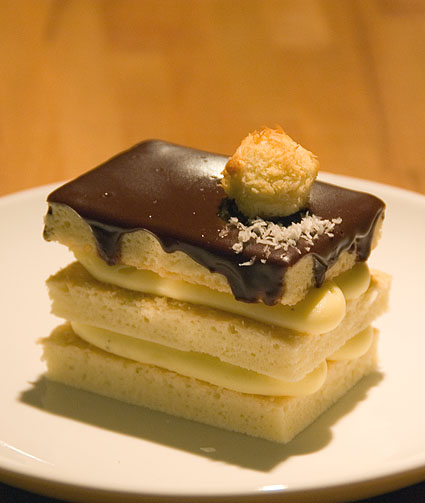
I cut this Daring Bakers Challenge close. I waited until the last day and pretty close to the last hour to get this cake made and posted!

This month the bakers took on the challenge of a Bostini Cream Pie. I’d probably classify this as a restaurant version of the classic dessert; it is small, loaded with eggs and cream, and intended to be made in individual servings. If you check the recipe, you’ll see that the recipe is actually from a restaurant so my initial impressions were correct.

As is true with many pastries, this one is easily broken into several basic parts: chiffon, pastry cream, and ganache. I chose to make a few (allowed) adjustments to the recipe: using coconut milk in place for orange juice, only making a half recipe of pastry cream, and coming up with my own presentation. I was surprised to see how much pastry cream there was leftover even with half the recipe; I’m sure I can find a way to make it disappear though.

I served this to the eater and my parents tonight and the pies disappeared shortly before I was done taking photos. I’d consider making this dessert again but I’d change a few things up that are mostly personal preference. I’d probably choose a thinner cake like a joconde and would most definitely use a pastry cream that is a bit less rich. I was really surprised at how thick it was after it was chilled. I prefer a cream with a lighter, less dense, texture. I might even soak the sponge with some sort of boozey concoction that would tie all the flavors together.

Here’s the original recipe to try, if you dare…

Bostini Cream Pie
(from Donna Scala & Kurtis Baguley of Bistro Don Giovanni and Scala’s Bistro)
Makes 8 generous servings

INGREDIENTS:

Custard

3/4 cup whole milk
2 3/4 tablespoons cornstarch
1 whole egg, beaten
9 egg yolks, beaten
3 3/4 cups heavy whipping cream
1/2 vanilla bean
(EDITED: vanilla extract is okay)
1/2 cup + 1 tablespoon sugar

Chiffon Cake

1 1/2 cups cake flour
3/4 cup superfine sugar
1 1/3 teaspoons baking powder
1/3 teaspoon salt
1/3 cup canola oil
1/3 cup beaten egg yolks (3 to 4 yolks)
3/4 cup fresh orange juice
1 1/2 tablespoons grated orange zest
1 teaspoon pure vanilla extract
1 cup egg whites (about 8 large)
1 teaspoon cream of tartar

Chocolate Glaze

8 ounces semi or bittersweet chocolate
8 ounces unsalted butter

INSTRUCTIONS

To prepare the custard:

Combine the milk and cornstarch in a bowl; blend until smooth. Whisk in the whole egg and yolks, beating until smooth. Combine the cream, vanilla bean and sugar in a saucepan and carefully bring to a boil. When the mixture just boils, whisk a ladleful into the egg mixture to temper it, then whisk this back into the cream mixture. Cook, stirring constantly, until the mixture is thick enough to coat the back of a spoon. Strain the custard and pour into 8 large custard cups. Refrigerate to chill.

To prepare the chiffon cakes:

Preheat the oven to 325°F. Spray 8 molds with nonstick cooking spray. You may use 7-ounce custard cups, ovenproof wide mugs or even large foil cups. Whatever you use should be the same size as the custard cups.

Sift the cake flour, sugar, baking powder and salt into a large bowl. Add the oil, egg yolks, orange juice, zest and vanilla. Stir until smooth, but do not overbeat.

Beat the egg whites until frothy. Add the cream of tartar and beat until soft peaks form. Gently fold the beaten whites into the orange batter. Fill the sprayed molds nearly to the top with the batter.

Bake approximately 25 minutes, until the cakes bounce back when lightly pressed with your fingertip. Do not overbake. Remove from the oven and let cool on a wire rack. When completely cool, remove the cakes from the molds. Cover the cakes to keep them moist.

To prepare the glaze:

Chop the chocolate into small pieces. Place the butter in a saucepan and heat until it is just about to bubble. Remove from the heat; add the chocolate and stir to melt. Pour through a strainer and keep warm.

To assemble:

Cut a thin slice from the top of each cake to create a flat surface. Place a cake flat-side down on top of each custard. Cover the tops with warm chocolate glaze. Serve immediately.

the dude

Category: pastry | 31 Comments »