My Food Geek

he cooks, she eats :)

subscribe to
posts
comments

Archive for December, 2006

Little ears?

December 25th, 2006 by geek

plated ears

Last roll the earnight my friend Marcelo and I made orecchiette for Christmas Eve dinner. I roped Marcelo into making the pasta with me since individually crafting each piece of pasta is a bit time consuming if done alone. I made a simple pasta dough from semolina, high-gluten flour, and water; nothing else. After working the dough on the counter, we rolled it out, sliced it up, and pressed out a whole bunch of orecchiettes.

The recipe I came up with used radish tops, sauteed radishes, and Italian sausage. “Cooked radishes?” you say? I thought the exact same thing when I made this in the past using penne pasta and omitting the sausage. The radishes take on an almost turnip flavor, much more mellow than their raw counterparts. The greens aren’t anything new and taste very much like spinach. A little bit of olive oil and red wine holds the whole dish together.

sliced radishesOrecchiette, sausage, and radishes

1lb orecchiette
3 Italian sausages, casings removed
2 bunches of radish greens
1 bunch of radishes
1 cup red wine
6tbls olive oil

Bring a large pot of water to a boil.

While the water is coming to a boil, cook sausage in 3 tablespoons of olive oil until lightly browned.

Add radishes and greens and stir into sausage. Reduce heat to low and simmer for 5 minutes to blend flavors.

Cook orecchiette according to directions (if using fresh made, cook until they begin to float)

ears cooking

Add cooked pasta to sausage and radish mixture and add red wine. Simmer for a few more minutes to combine flavors. Add the remaining olive oil and correct seasonings.

Category: savory | 1 Comment »

Playing with Chocolate (part 1)

December 22nd, 2006 by geek

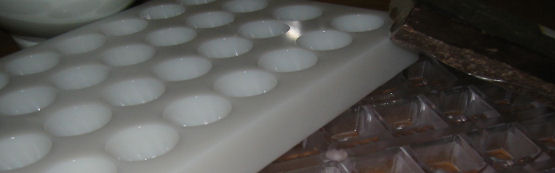
A few weeks ago I ordered a few new chocolate molds from Chocolat-Chocolat online. They seem to be of high quality, two from a French maker and one from a Chinese maker. I was itching to try them out, but did not have any couverture in the pantry. Luckily, it’s the holidays and Whole Foods had a huge display of couverture to choose from; I chose Scharffen Berger 60%.
Chocolate Molds

Making chocolates lies somewhere between science and art. The science is in properly tempering the chocolate so it will crystallize properly. The art is in getting them to look nice and taste good after you extract them from the molds. For now, I’m just going to concentrate on the scienceTempering chocolate.
There are a few methods for tempering chocolate; I chose one of the quickest and easiest, the seeding method. The basic idea is to melt about two-thirds of the chocolate and bring it to about 120F then add unmelted, chopped chocolate to cool the chocolate to 92F. These two steps are pretty easy to do; the hard part is keeping the mixing at 92F once you get it there in the first place. This usually entails several visits to the bain-marie to keep the temperature as constant as you can. Once you get to this stage, you’re ready to fill the molds.

Chocolate in moldsFilling the molds is easy, albeit a bit on the messy side. Basically you just ladle the chocolate into the molds, slide a spatula or pastry blade along the top to clean off the excess chocolate, then let sit. After a minute or so, turn the whole works upside-down and tap the molds to remove the excess chocolate. Once that’s done, you put the mold upside-down on a piece of parchment and chill until solid. Next, pipe in your filling of choice, apply another layer of tempered chocolate, and remove the excess with a pass of a spatula and let set. IfPiping Filling everything was done properly, in a few minutes your candies will pop out of the molds.

Since this was my first try, I’m choosing to omit a finished product. I’ll consider this an experiment; I’ll show the final products in part two.

To Be Continued…

Category: pastry | 2 Comments »

The Flavor of Thailand

December 20th, 2006 by eater

There are few things in the world that I find more pleasant than snuggling up with the dog on the couch while delicious food creations are conjured in the kitchen, filling the house with wonderful scents.

I had the pleasure of that experience the other night while Jef created this Thai curry soup. He used coconut oil for this one, so the distinct but delicate scent of coconut was already wafting through the air from the moment the cooking began.
Green curry soup cooking

This was a perfect soup for a cold night, with the warmth of soup and warmth of spicy green curry both working to take away the winter chill.

Green Curry Soup
2 tilapia fillets
1/2 lb shrimp, peeled but tails left on
2 potatoes, peeled and dicedGreen curry soup in bowl
3 carrots, peeled and roll cut
6 baby bok choi, whole - bottoms removed
2 cloves garlic 1 tsp ginger
6 green onions
1 Tbsp Thai green curry paste
1 can cream of coconut (coconut milk may be used)
3 Tbsp oil (preferably coconut oil)
Thai fish sauce (to taste)

rice noodles or rice, prepared


Mince garlic, ginger, and the whites of the green onion. Saute in oil until fragrant.

Add green curry paste and saute for 1 minute.

Add coconut cream and 4 times as much water.

Add potatoes and carrots and bring to a boil.

Cook until potatoes are fork-tender, then add the seafood and bok choi and reduce to a simmer.

Simmer for about 5 minutes or until the fish is flaky and the shrimp have turned pink and curled.

Server over cooked rice noodles or steamed rice.

Garnish with scallion tops and chopped cilantro.

Category: savory | No Comments »

An ode to pizza

December 13th, 2006 by geek

dough ingredients

Ahhh, pizza. Who doesn’t love your thin crust, your melted cheese, and all of the wonderful toppings that are piled upon you? Pizza is so loved that you can get it almost anywhere in the world with any topping you can imagine.

This flatbread is the perfect vehicle for just about any topping you desire. From the common Italian marinara and mozzarella to the more creative Brazilian chocolate and banana, pizza is a world traveler that does not discriminate. While I like experimenting with foods, I prefer to stick to the basics with pizza: marinara, mozzarella, and basil.

throwing the doughThe base of the pizza, the dough, has probably as many variations as the toppings that are layered upon it. Different cultures and regions claim their recipe is the best. The same goes with how the dough is prepared. The dough is sometime rolled out, stretched by hand, or my favorite, thrown into the air.

When I attended culinary school, I found that throwing the dough actually had a purpose (other than just plain fun). By throwing the dough into the air with a circular motion, you actually help stretch the dough out symmetrically into the all-important pizza shape. While the same results can be achieved by rolling out the dough and stretching it by hand, it just isn’t as satisfying as throwing the dough in the air, especially if you have guests over to watch the theatrics.

Basic Pizza Doughrolling the dough
15g yeast
180ml water (90-110F)
5g sugar
30ml olive oil
5g salt
15ml honey
285g flour (bread or high gluten)

If you have a pizza stone, now is probably the best time to put it in the oven.

Preheat oven to 550°F (or as hot as it will go)

Mix yeast, water, honey and sugar in the bowl of a mixer and let stand for about five minutes until the mixture starts to bubble.

Add olive oil, salt, and all but a few handfuls of flour in the bowl and mix with the dough hook. Adjust the consistency with the extra flour, scraping down the sides as you go.stretching the dough

The dough is ready when it is smooth and elastic and comes away from the side of the bowl.

Remove from mixing bowl, form into a ball, and place in a lightly oiled bowl. Let rise until doubled in volume (about 2hrs).

Punch down, reshape, and let rest in refrigerator overnight. This step isn’t absolutely necessary but it helps develop more flavorful dough.

Divide the dough in half and form circles about 30cm in diameter. Top with your favorite ingredients.

Bake directly on pizza stone for about 10min or until the crust is browned and cheese is melted.

Pizza

Category: savory | No Comments »

And so it begins

December 10th, 2006 by eater

Such a fitting start, the beautiful French macaron: two smooth and delicate meringue-like rounds flavored however the chef pleases, usually made in someModeling Macarons beautiful pastel color that reflects the flavor, and sandwiched with some wonderful, complementary flavored filling between. They are generally made either as standard three inch rounds or small one inch miniatures.
He has made them in raspberry, blackberry, pistachio, chocolate, and orange with various fruit or chocolate fillings. They are always sublime creations that disappear quickly. The outside of the pastry has a slight crispness to it, and a slightly soft moistness inside with the center filling always an irresistible match.
His latest creation is a very Japanese take on the macaron, a green tea, or matcha, flavored pastry with red bean paste, or an, filling.

Matcha Macaron
110g almond powderSushi plate macarons
140g powdered sugar
7g matcha (powdered green tea)
90g egg whites
60g granulated sugar
Enough red bean paste to fill about five dozen miniature macarons

Preheat oven to 305°F

Place almond powder, powdered sugar, and matcha in a food processor. Process with metal blade until thoroughly combined.

Beat whites in a bowl with an electric mixer at high speed. As the whites begin to foam, add sugar in a slow stream while mixing. Continue mixing at high speed until whites reach stiff peaks.

Fold almond mixture into egg whites in three additions. The mixture will deflate quite a bit. Continue folding until mixture is fully combined and shiny.

Immediately fill a pastry bag fitted with a 11mm round tip and pipe into rounds onto a baking sheet lined with a silpat baking mat.

Leave macarons out to dry for about 30 minutes or until they do not stick to your finger when touched.

Drying Macarons

When macarons are sufficiently dry, place in the oven to bake. After about five minutes, a ruffled skirt should develop around the bottom edge of each macaron. Rotate the baking sheet by 180 degrees, and bake for another five to seven minutes.

Check to see if macarons are done by grabbing the top of one macaron and trying to shake it. They are done when the top barely slides against the skirt. If they are not done, extend baking time by two minutes intervals, checking after each extension.

Move silpat to a cooling rack. After macarons have cooled enough to touch, remove them from silpat and place upside down on rack.If they do not easily come off silpat, place in freezer for a few minutes and try again.

Sandwich macarons together with smooth red bean paste.

Piping Macaron Filling

Keep macarons in the freezer and serve chilled. Macarons are best the day after baking, giving them time to dry out a bit.

Makes about five dozen macarons.

Macarons in Dish

Category: pastry | 2 Comments »